Chicago, Illinois
When a sewer lateral is beyond patching, Trenchless Sewer Line Replacement in Chicago can restore flow without turning your yard, sidewalk, or parkway into an excavation zone. Chicago Sewer Line Replacement Pros plans replacements to align with City of Chicago permit requirements and modern materials used in plumbing systems that move wastewater safely away from the building. Our team focuses on trenchless replacement methods (not CIPP lining) for pipes that have collapsed, bellied, or lost structural integrity.
Chicago Sewer Line Replacement Pros is a dedicated sewer line company in Chicago, Illinois, specializing in trenchless sewer line replacement. Our technicians use the latest trenchless technology and HD camera inspection equipment to deliver accurate diagnoses and lasting repairs with minimal disruption to your property.
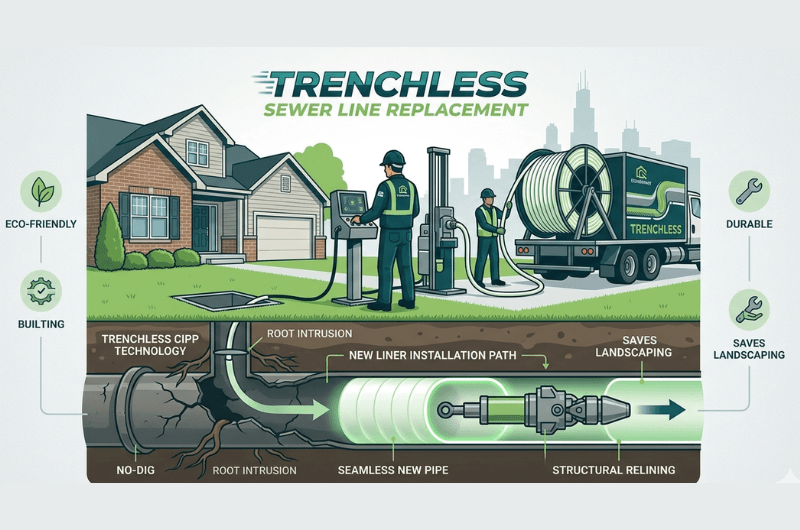
Trenchless sewer line replacement is a method of installing a new pipe with limited surface disruption by using controlled access pits and specialized equipment instead of continuous trenching. Two common replacement techniques are pipe bursting with a hydraulic bursting head and static rod system, and directional boring using an HDD (horizontal directional drilling) rig with a locating transmitter to keep the bore on grade. During setup, isolation valves (where applicable) and temporary bypass pumping may be used to control flow while the sewer lateral is replaced from foundation wall to the city main connection.
This service is typically used when the existing line has structural failures that a lining product cannot reliably bridge. In Chicago’s older housing stock, issues often include vitrified clay pipe fractures at bell-and-spigot joints, severe root intrusion that has displaced sections, and corrosion or cracking in cast iron where the invert is heavily deteriorated. Trenchless pipe replacement also addresses chronic backups caused by negative slope (“belly”) and offsets that trap solids, creating repeated clogs even after snaking or jetting.
Our trenchless replacement approach is planned like a utility project: verify route and depth, replace the full run, then confirm performance. Step 1 is a site walk and utility coordination using JULIE (811) marking and an electromagnetic utility locator to reduce conflict with gas, electric, and telecom. Step 2 is establishing entry/exit pits and setting grade; when pipe bursting is appropriate, a pulling unit and hydraulic power pack draw the bursting head through the old pipe while expanding the bore. Step 3 is installing the new line (often HDPE fused with a McElroy fusion machine) or new PVC in appropriate diameters, then reconnecting to the building drain and public sewer with code-compliant fittings. Step 4 is verification using a sewer camera for post-install documentation and to confirm there are no sags, obstructions, or connection defects.
Material selection and workmanship standards matter because plumbing is a system of pipes, valves, fixtures, and related apparatus that protects public health through safe waste removal. For replacements, we commonly specify HDPE (high-density polyethylene) for pipe bursting due to its continuous fused joints and flexibility, and PVC SDR-26 or SDR-35 where site conditions and code allow. Installations are performed with attention to ASTM standards commonly applied to trenchless work (such as ASTM F1962 for directional boring of PE pipe and ASTM F2164 for pipe bursting), and materials are selected to meet applicable NSF/ANSI listings for manufactured pipe components when required. Every replacement includes bedding/compaction practices suited to the existing soils and a final flow test to confirm the line carries wastewater correctly.
Chicago’s plumbing infrastructure has deep roots in history—early sewer conveyance used clay pipes thousands of years ago—and modern replacements still rely on the same core goal: moving wastewater reliably through a sealed pipeline. In the developed world, plumbing systems are considered critical to sanitation and public health, and the U.S. Environmental Protection Agency reports that approximately 23,000–75,000 sanitary sewer overflows occur in the United States each year. Replacing a failing lateral with a trenchless pipe renewal-by-replacement method reduces the risk of sewage release on the property and helps stabilize drainage performance for the building.
Trenchless sewer replacement in Chicago has to account for freeze–thaw cycles, heavy spring rains, and dense utility corridors common in older neighborhoods. In areas like Lincoln Park and Logan Square, many properties still have aging clay or cast-iron laterals running under sidewalks and parkways, where continuous excavation can be disruptive and may trigger additional public way restoration. Chicago Sewer Line Replacement Pros plans routes and access pits with City of Chicago Department of Buildings requirements in mind and coordinates JULIE (811) utility markings to reduce conflicts with gas services, water lines, and telecom—especially on tight lots, alley-access garages, and multi-unit buildings common across the North Side and Near West Side.
When it comes to trenchless sewer line replacement in Chicago, our team brings specialized equipment and years of focused experience. We diagnose the problem accurately with HD camera inspection, then recommend the most cost-effective solution — whether that's trenchless repair, CIPP lining, or traditional replacement.
Trenchless Sewer Line Replacement pricing in Chicago typically depends more on site conditions than a flat rate. Cost drivers include: (1) linear footage from the foundation to the city main, (2) depth of the existing sewer and need for shoring, (3) method used (pipe bursting vs directional boring), (4) pipe diameter (commonly 4-inch or 6-inch laterals), (5) number of bends and connection complexity, (6) restoration requirements (concrete sidewalk, pavers, parkway), and (7) permit/inspection requirements. Homes with deep laterals, heavy clay soils, or street/sidewalk constraints generally require more labor and equipment time. Request an estimate to get a scope-specific range based on your route, depth, and replacement method.
Most trenchless sewer line replacements are completed in 1–2 days once permits and utility markings are in place. A straightforward pipe-burst replacement with clear access pits can often be finished in a single day, while deeper lines, difficult reconnections, or concrete restoration may extend the timeline. Factors that affect duration include depth, soil conditions, length of run, weather, access limitations, and whether bypass pumping is required to keep fixtures usable during work.
In many cases, yes—sewer lateral replacement work in Chicago commonly requires a plumbing permit and may require inspection, especially when the work involves the connection to the public sewer or work in the public way (sidewalk/parkway). Requirements can vary based on property type and scope, so the safest approach is to confirm with the City of Chicago Department of Buildings and any public way rules that apply. Chicago Sewer Line Replacement Pros can help identify the applicable permits and coordinate the inspection steps as part of the project plan.
You may need trenchless replacement (not just cleaning or lining) when there are structural failures such as: repeated backups despite snaking, standing water in the line indicating a belly, frequent root re-entry with displaced pipe sections, visible collapse or major cracking on camera, sewage odors near the foundation, sinkholes or soft spots along the lateral route, or persistent slow drains across multiple fixtures. If the pipe has lost its shape, has large offsets, or is crushed, replacement is often the appropriate solution because the pipe can’t reliably carry wastewater or maintain grade.
Tell us about your project — we'll connect you with an independent professional in Chicago.