Chicago, Illinois
Traditional Sewer Line Replacement in Chicago is still the correct solution when a sewer is collapsed, severely offset, or beyond lining. Chicago Sewer Line Replacement Pros follows City of Chicago Department of Buildings requirements and uses documented inspection steps to confirm replacement is necessary. If your drain problems keep returning despite cleaning, a dig-and-replace approach can restore full pipe grade and capacity.
Chicago Sewer Line Replacement Pros is a dedicated sewer line company in Chicago, Illinois, specializing in traditional sewer line replacement. Our technicians use the latest trenchless technology and HD camera inspection equipment to deliver accurate diagnoses and lasting repairs with minimal disruption to your property.
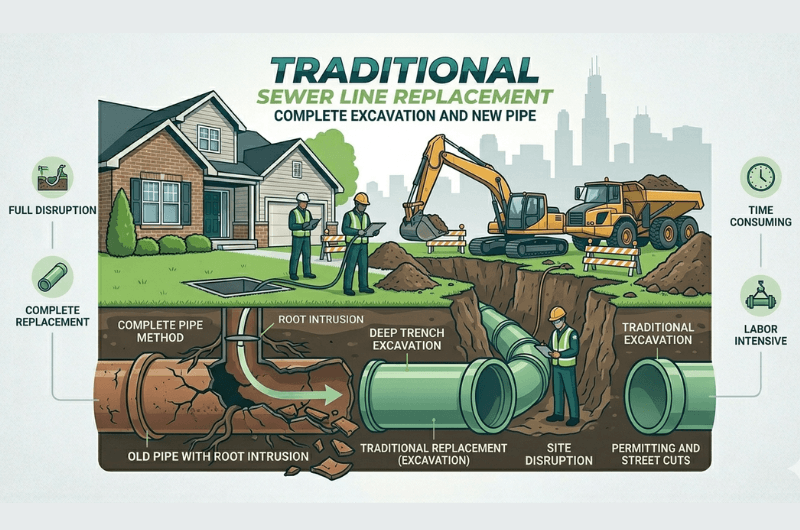
Traditional sewer line replacement is a full excavation-and-rebuild method: we expose the failed lateral, remove damaged sections, and install new pipe on proper slope back to the City main. Typical equipment includes a mini-excavator for tight lots, trench shoring boxes for safety, and a rotating laser level to set grade; we also use SDR-35 PVC or ductile iron depending on location and depth. This approach is different from lining because it physically corrects pipe bellies, offsets, and collapsed segments rather than coating the interior.
This service solves problems that mechanical cleaning or patching cannot. Common technical failures in Chicago include crushed vitrified clay (VCP) from settlement, cracked cast-iron with heavy tuberculation, and separated joints where groundwater washes out bedding. Root intrusion at joints, a sewer “belly” (negative slope), and misaligned fittings can cause recurring backups even after augering; if a camera shows missing pipe wall or severe deformation, replacement is usually the durable fix. Tools like a Ridgid SeeSnake camera and a sonde locator help confirm depth and alignment before digging.
Our traditional replacement process is methodical and documented. First, we locate utilities through JULIE/811 and confirm the route with a camera inspection and electronic locating equipment; then we plan excavation limits and set up site protection. Next, we excavate to the lateral using a mini-excavator and hand-dig around sensitive areas, place trench boxes as needed, and remove the failed pipe back to sound transitions. After bedding is prepared, we install new pipe with shielded no-hub couplings (Mission or Fernco Proflex style where appropriate), verify slope with a laser, and perform a water or low-pressure test if required; we finish with proper backfill compaction and coordinate any City inspection.
Materials and standards matter because Chicago soils and freeze-thaw cycles can punish poor installations. We commonly install SDR-35 ASTM D3034 PVC for laterals, Schedule 40 PVC in certain transitions, or ductile iron (AWWA C151) where extra strength is needed; fittings are solvent-welded to ASTM D2564 cement requirements and transitions use stainless-steel banded couplings. Work is aligned with OSHA 29 CFR 1926 Subpart P trench safety rules and City of Chicago plumbing/building requirements, including cleanout placement and accessible points for future maintenance. A practical benchmark: many older Chicago homes still have clay or cast-iron laterals, and a typical service lateral is often in the 4-inch to 6-inch diameter range—when these lines fail structurally, replacement restores full internal diameter and flow capacity.
Chicago’s freeze-thaw cycles, heavy spring rains, and older housing stock make traditional excavation a practical option when a lateral has shifted or collapsed. In neighborhoods with vintage two-flats and bungalows—such as Portage Park and Beverly—laterals are often original clay or cast iron and may run under narrow gangways, patios, or basement slabs, requiring careful grade-setting and shoring. We plan around City of Chicago Department of Water Management infrastructure, coordinate JULIE/811 utility marking, and account for local soil conditions so the replaced line meets City expectations for slope, cleanouts, and durable restoration.
When it comes to traditional sewer line replacement in Chicago, our team brings specialized equipment and years of focused experience. We diagnose the problem accurately with HD camera inspection, then recommend the most cost-effective solution — whether that's trenchless repair, CIPP lining, or traditional replacement.
Traditional Sewer Line Replacement in Chicago commonly ranges from about $6,000 to $20,000+, depending on the length of lateral replaced, depth of excavation, and site access. Costs increase when the line runs under a basement slab, a detached garage, or mature trees, or when trench shoring and dewatering are needed due to groundwater. Pipe material (SDR-35 PVC vs ductile iron), the number of required cleanouts, concrete/landscape restoration, and City permit/inspection requirements also affect total price. The most accurate way to price it is to confirm the failure location and depth with a camera and locator, then build a scope based on measured footage and restoration needs.
Most traditional sewer line replacements take 1–3 days for typical residential laterals, with timeline driven by excavation depth, soil conditions, and restoration (concrete, pavers, landscaping). A straightforward yard excavation with good access may be completed in a single day, while work that involves a basement floor break, multiple utility crossings, or City inspection scheduling can extend to several days. Weather and groundwater conditions can also add time if dewatering or additional trench protection is required.
In many Chicago cases, yes—sewer lateral replacement often requires permits and inspection coordination through the City of Chicago Department of Buildings, especially when altering piping, connecting to the City sewer, or excavating in areas tied to public infrastructure. Requirements can vary by scope (full lateral vs partial replacement), location (private property vs parkway), and whether work impacts sidewalks or the public way. A licensed plumbing contractor can confirm the correct permit path and schedule required inspections for compliance.
You may need Traditional Sewer Line Replacement if you have: (1) repeated sewer backups after professional cleaning, (2) camera evidence of a collapsed pipe, severe deformation, or missing pipe wall, (3) chronic root intrusion at separated joints in clay pipe, (4) a confirmed sewer belly/standing water that causes slow drains across multiple fixtures, (5) foul odors or sewage seepage in the yard or basement, and (6) sinkholes or persistent wet spots along the sewer route. A camera inspection with locating can verify whether the issue is structural (replacement) or maintenance-related (cleaning/spot repair).
Tell us about your project — we'll connect you with an independent professional in Chicago.