Chicago, Illinois
When a sewer line is failing but excavation isn’t practical, Trenchless Sewer Line Repair (CIPP Lining) can rebuild the pipe from the inside. Chicago Sewer Line Replacement Pros uses NASSCO PACP-informed inspection practices and engineered resin systems to help restore flow and structural integrity. If your property shows recurring backups or intrusion issues, Trenchless Sewer Line Repair (CIPP Lining) is often the most targeted repair option.
Chicago Sewer Line Replacement Pros is a dedicated sewer line company in Chicago, Illinois, specializing in trenchless sewer line repair (cipp lining). Our technicians use the latest trenchless technology and HD camera inspection equipment to deliver accurate diagnoses and lasting repairs with minimal disruption to your property.
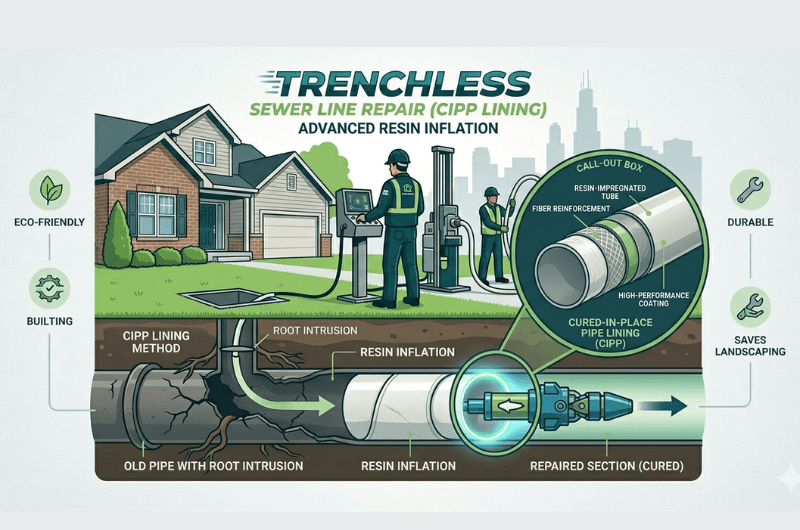
Trenchless Sewer Line Repair (CIPP Lining) is an internal pipe rehabilitation method that creates a “pipe-within-a-pipe” using a resin-saturated liner. We use a CCTV sewer camera with a self-leveling camera head to verify line condition and measurements, then install the liner using inversion lining or a pull-in-place technique. For curing, we may use ambient cure, hot-water cure, or UV CIPP curing equipment depending on access, diameter, and site constraints.
This cured-in-place pipe repair is commonly used for structural defects that don’t require full pipe replacement—like longitudinal cracks, circumferential fractures, offset joints, and infiltration pathways. It can also address root intrusion once the host pipe is cleared and structurally suitable, and it can reduce infiltration/inflow (I/I) that contributes to wet-weather backups. In Chicago’s older building stock, cast iron and vitrified clay pipe often develop joint separations and corrosion roughness; CIPP lining restores a smooth interior wall to improve hydraulic performance.
Our approach is designed to be verifiable and repeatable. Step 1: a pre-lining CCTV inspection and distance-counting sonde verification to map defects and confirm cleanouts and access points. Step 2: host-pipe preparation using a mechanical chain flail or rotary cutter to remove scale and roots, followed by controlled cleaning so the liner bonds properly. Step 3: liner wet-out (or delivery of a factory wet-out liner) and installation via inversion drum or pull-in rig, then curing with temperature and time monitoring. Step 4: reinstatement of laterals with a robotic cutter and a final post-lining camera inspection to document the finished liner.
Materials and quality controls matter in cured-in-place pipe lining. We specify ASTM F1216-based design considerations for lining performance and use epoxy or vinyl ester resins selected for sewage exposure and temperature limits. Liner felt or fiberglass carriers are chosen based on diameter, structural needs, and curing method, and we track cure parameters to support consistent results. Where applicable, our inspection documentation aligns with NASSCO PACP coding, and we maintain job records that can be shared with owners, property managers, or municipal reviewers.
Trenchless Sewer Line Repair (CIPP Lining) is not the same as cleaning, jetting, or a replacement project—its purpose is structural rehabilitation and sealing inside the existing alignment. A properly installed CIPP liner can restore internal diameter consistency and reduce snag points that catch debris. In many residential and light commercial scenarios, the on-site lining work is often completed within a day, and many lined systems are commonly engineered for a 50-year design life depending on resin system, thickness design, and operating conditions.
Chicago’s freeze–thaw cycles and shifting soils can accelerate joint movement in older vitrified clay and cast iron sewer laterals, especially in neighborhoods with vintage housing and mature parkway trees. Chicago Sewer Line Replacement Pros performs Trenchless Sewer Line Repair (CIPP Lining) across the city with attention to City of Chicago permitting pathways and access constraints common in tight gangways and basement utility rooms. From Lincoln Park’s older masonry buildings to bungalow corridors in Portage Park, we plan lining projects around existing cleanouts, parkway tree roots, and the realities of working near the Chicago Department of Water Management connection points.
When it comes to trenchless sewer line repair (cipp lining) in Chicago, our team brings specialized equipment and years of focused experience. We diagnose the problem accurately with HD camera inspection, then recommend the most cost-effective solution — whether that's trenchless repair, CIPP lining, or traditional replacement.
Trenchless Sewer Line Repair (CIPP Lining) pricing in Chicago is typically influenced by pipe diameter, total linear footage, number of reinstated laterals, and site access (cleanout availability, basement access, or manhole access). Cost also changes based on curing method (ambient, hot-water, or UV), required prep work (chain flail descaling, root removal), and whether spot repairs or full-length lining is needed. A contractor will usually confirm the scope with a pre-lining CCTV inspection and measurements; the most accurate way to price is to match liner thickness/design to the defect severity and pipe material.
Many CIPP lining projects are completed in 1 day, but timing depends on the pipe length, diameter, and how much preparation is required. Setup and pre-inspection may take 1–2 hours, pipe preparation (descaling/root cutting) can take several hours on older cast iron or clay, and curing time varies by method (ambient cure is often longer; hot-water or UV curing can be faster). Final steps—robotic reinstatement of laterals and a post-lining camera inspection—typically add 1–3 hours depending on how many branch connections exist.
Permit requirements in Chicago can depend on whether the work alters the building sewer connection, involves excavation in the public way, or changes plumbing beyond internal rehabilitation. Trenchless Sewer Line Repair (CIPP Lining) often involves access from an existing cleanout or interior point, but permits may still be required under City of Chicago plumbing code enforcement and, in some cases, coordination with the Department of Water Management. The most reliable approach is to verify the scope after the camera inspection and confirm permitting needs based on location (private property vs. parkway/public way) and the exact access method.
Common signs that cured-in-place pipe lining may be appropriate include: recurring backups that return after snaking, frequent root intrusion at the same distance on camera, visible cracks or separated joints on CCTV footage, persistent seepage/infiltration that worsens after rain, and heavy interior pipe corrosion or scaling that reduces flow area. You may also notice gurgling drains, sewage odor near a cleanout, or slow fixtures across multiple drains (not just one). The deciding factor is usually the camera inspection: CIPP is typically considered when the pipe is still in a continuous alignment but has structural defects that can be rehabilitated from the inside.
Tell us about your project — we'll connect you with an independent professional in Chicago.