Chicago, Illinois
When drains back up or a sewer odor won’t go away, guessing can waste time and money—Sewer Camera Inspection in Chicago gives a direct view inside the line. Chicago Sewer Line Replacement Pros uses professional-grade push-rod cameras and locating equipment operated by trained technicians familiar with City of Chicago plumbing requirements. The result is clear, documented findings you can use to plan the right next step.
Chicago Sewer Line Replacement Pros is a dedicated sewer line company in Chicago, Illinois, specializing in sewer camera inspection. Our technicians use the latest trenchless technology and HD camera inspection equipment to deliver accurate diagnoses and lasting repairs with minimal disruption to your property.
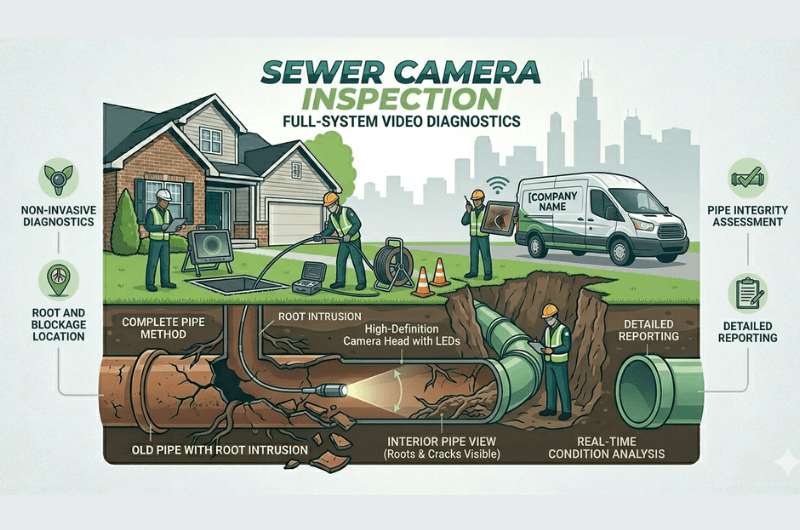
Sewer Camera Inspection is a diagnostic service that uses a waterproof, self-leveling HD inspection camera mounted on a fiberglass push rod to travel through your lateral sewer line. We typically pair the camera with a sonde transmitter and a RIDGID SeekTech locator (or equivalent) to map the camera head’s position from the surface, then record findings on a digital DVR for review. This method allows us to identify pipe defects without excavating and to document the internal condition of clay tile, cast iron, or PVC sewer piping.
This inspection is commonly used to pinpoint technical issues that don’t show up from the surface: root intrusion at clay tile joints, bellies (negative slope) holding standing water, cracked cast iron with flaking scale, and offset joints that catch paper and solids. It’s also effective for confirming cross-bore risks near utility corridors and locating obstructions like collapsed sections, heavy grease buildup, or construction debris. In many Chicago homes, a small defect at a transition (for example, cast iron to clay) can create recurring blockages—camera footage shows the exact failure point.
Our approach is structured so you get usable answers, not just video. Step 1: we identify the best access point (cleanout, stack, or building drain) and protect the work area with containment and floor protection. Step 2: we run the inspection camera upstream and downstream as needed, documenting distance readings from the push-rod counter and marking key locations with the sonde/locator. Step 3: we verify line direction and depth, then provide time-stamped footage, still images, and a written summary noting pipe material, diameter, and defect types based on NASSCO PACP-style condition observations.
Quality and compliance matter because inspection results often guide repair decisions and real estate negotiations. We follow manufacturer protocols for RIDGID and Milwaukee inspection systems, use calibrated locating equipment, and document findings in a format compatible with common plumbing reporting needs. Work is performed with attention to City of Chicago Plumbing Code expectations for access points and sanitary drainage, and we follow OSHA 29 CFR 1926 jobsite safety practices when locating lines outdoors. When applicable, we reference IPC concepts for drainage function (slope, flow, and venting) to explain why a defect is causing symptoms.
You’ll also get practical, actionable outputs. We provide a clear map of defect locations relative to fixed points (foundation wall, curb line, or alley), plus depth estimates when the locator signal allows. As a data point, many push-camera systems record at 30 frames per second, which helps capture brief details like hairline cracks, weeping joints, and minor offsets that can be missed in a quick look. If you’re coordinating with a plumber, realtor, or insurer, our recorded inspection package supports informed decision-making and avoids unnecessary work.
Chicago properties often have older clay tile and cast iron laterals, and freeze–thaw cycles plus shifting soils can contribute to joint movement and cracking over time. We provide Sewer Camera Inspection across the city, including neighborhoods like Logan Square and Beverly, where mature tree roots and aging infrastructure frequently affect sewer lines. We also account for local site conditions—tight gangways, alley access, and basements with overhead sewers—while staying mindful of City of Chicago requirements and common inspection needs for real estate transactions in Cook County.
When it comes to sewer camera inspection in Chicago, our team brings specialized equipment and years of focused experience. We diagnose the problem accurately with HD camera inspection, then recommend the most cost-effective solution — whether that's trenchless repair, CIPP lining, or traditional replacement.
Sewer Camera Inspection cost in Chicago commonly depends on access, line length, and whether locating is needed. Pricing is typically influenced by: (1) whether there is an exterior cleanout or only an interior access point, (2) the total distance inspected (many laterals range roughly 50–150 feet), (3) if a sonde/locator mapping is required to mark depth and location, and (4) whether the line needs clearing first to get usable video. Request an estimate to confirm pricing for your property and goals (troubleshooting, pre-purchase inspection, or documentation for a repair plan).
Most Sewer Camera Inspections take about 45–90 minutes on site, including setup, running the camera, locating key points, and reviewing footage. It can take longer if access is difficult, the line is heavily obstructed, or multiple branches/cleanouts need to be checked. If the pipe is holding standing water (a belly) or is fully blocked, the inspection may be staged so the line can be made passable before final documentation.
In most Chicago situations, a Sewer Camera Inspection itself does not require a permit because it is a non-invasive diagnostic service that does not alter plumbing. Permits are typically associated with work that modifies or replaces drainage piping, excavates in the public way, or involves connection work near the City sewer. If your inspection is part of a larger scope, we can explain when City of Chicago permits may apply based on the planned repair or replacement.
You may need Sewer Camera Inspection (also called a sewer scope inspection, drain camera inspection, or video pipe inspection) if you notice: recurring backups after snaking, gurgling sounds at fixtures, sewage odor in the basement, slow drains in multiple fixtures at once, water pooling near a cleanout, or sudden changes after heavy rain. It’s also recommended before buying an older Chicago home with clay tile or cast iron, after tree root activity is suspected, or when you need to confirm whether the issue is a blockage, an offset joint, or a collapsed section.
Tell us about your project — we'll connect you with an independent professional in Chicago.