Chicago, Illinois
Recurring backups and gurgling drains often point to buildup deep in the main line, not a simple sink clog. Chicago Sewer Line Replacement Pros provides Sewer Line Cleaning in Chicago using IICRC-aligned safety practices and commercial-grade drain equipment to restore flow and reduce repeat blockages.
Chicago Sewer Line Replacement Pros is a dedicated sewer line company in Chicago, Illinois, specializing in sewer line cleaning. Our technicians use the latest trenchless technology and HD camera inspection equipment to deliver accurate diagnoses and lasting repairs with minimal disruption to your property.
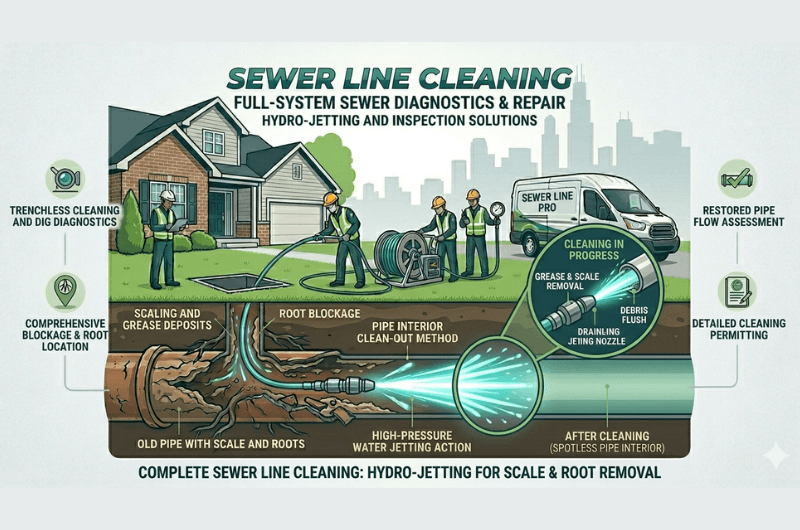
Sewer line cleaning is a controlled removal of obstructions and deposits from the building drain and main sewer lateral so wastewater can move freely again. Depending on the blockage type, we use a sectional drain machine (RIDGID K-60 class) with root-cutting blades, a drum auger for heavier cable runs, and a Wye fitting cleanout connection to work the line without stressing old piping. For verification, we may confirm flow and obstruction location using a Spartan Tool locator-compatible cable setup and a calibrated pressure gauge on flush-outs.
This service commonly solves problems caused by FOG (fats, oils, and grease) from kitchen lines, soap scum and biofilm buildup, and tree-root intrusion at joints. In Chicago’s older housing stock, cast iron “tuberculation” (internal scaling) and settled clay tile joints can narrow the pipe ID and catch debris, leading to recurring main-line clogs. Even a partial restriction can slow the system enough to trigger basement floor drain seepage, sewage odors from trapped gases, and intermittent backups when multiple fixtures discharge at once.
Our sewer pipe cleaning process is structured to clear the line while protecting the plumbing system. Step 1: we identify the best access point (interior cleanout, exterior cleanout, or stack base) and confirm pipe direction using a sonde-capable locator. Step 2: we select the correct cable diameter and cutting head—such as a C-cutter for grease or a root saw for fibrous intrusion—then perform staged passes to open the line, followed by polishing passes to remove residual buildup. Step 3: we re-establish flow with controlled flushing and verify drainage performance at multiple fixtures; when needed, we document findings using a pipe inspection camera to confirm clearance without turning the visit into a camera inspection service.
We follow safety and quality practices aligned with the IAPMO Plumbing Code principles and local code requirements for cleanout access and sanitary drainage systems. For work areas and contamination control, our crews use OSHA 29 CFR 1910 PPE practices (gloves, eye protection, and splash containment) and set up drain protection to prevent cross-contamination in basements and utility rooms. Where material conditions indicate risk—such as fragile Orangeburg pipe or heavily corroded cast iron—we adjust cable torque, use appropriate cutters, and avoid aggressive methods that can damage compromised pipe walls.
A practical data point: industry studies commonly cite that fats, oils, and grease contribute to a large share of sewer blockages—EPA guidance references that FOG can be a leading cause of sanitary sewer overflows in many communities. That’s why we focus on removing the actual deposit layer, not just punching a hole through it. We also provide maintenance recommendations based on pipe material (PVC Schedule 40 vs. cast iron vs. clay tile), fixture load, and usage patterns, including enzyme-safe routines and disposal practices that reduce future buildup without relying on harsh chemicals.
Chicago properties—especially in neighborhoods with older housing like Logan Square and Beverly—often have clay tile or cast iron laterals that collect scale and are vulnerable to root intrusion from parkway trees. Seasonal freeze-thaw cycles and heavy spring rains can also expose partially restricted lines by increasing flow demand and groundwater load near foundations. We perform Sewer Line Cleaning across the city with an approach that respects City of Chicago plumbing requirements, common basement configurations, and typical lot layouts, including tight gangways and shared alley access.
When it comes to sewer line cleaning in Chicago, our team brings specialized equipment and years of focused experience. We diagnose the problem accurately with HD camera inspection, then recommend the most cost-effective solution — whether that's trenchless repair, CIPP lining, or traditional replacement.
Sewer Line Cleaning cost in Chicago typically depends on access, pipe length, and the blockage type (grease, roots, or scale). Pricing is usually influenced by: (1) whether a usable cleanout is present or a toilet pull is required for access, (2) the distance to the city connection (longer laterals take more time and cable), (3) pipe material (cast iron and clay often need more passes than PVC), and (4) severity of root intrusion or heavy FOG. After locating the access point and confirming symptoms, contractors usually provide a written estimate based on the equipment needed (sectional machine vs. heavier drum machine) and time on site.
Most Sewer Line Cleaning appointments take about 1–3 hours. Light grease or soft buildup may clear in under an hour, while root intrusion or heavy scaling in older cast iron or clay tile can take longer due to multiple cutting and polishing passes. Time also increases if access is limited, if the cleanout is buried, or if fixtures must be tested across multiple levels of the home after the line is cleared.
In Chicago, routine sewer line cleaning performed through an existing cleanout typically does not require a permit because it does not alter piping, excavate, or change the drainage system. Permits are more commonly associated with installing new cleanouts, replacing pipe sections, or work that modifies the sanitary system under the City of Chicago Department of Buildings requirements. If access requires installing a cleanout or making plumbing modifications, ask your contractor whether a permit and a licensed plumber are required for that scope.
Common signs you may need sewer line cleaning include: (1) multiple drains slowing at the same time (tubs, sinks, and floor drains), (2) gurgling sounds after flushing due to air displacement in a restricted main, (3) sewage odors near a basement floor drain or cleanout, (4) backups that occur when running the washer or shower (high-volume discharge), and (5) repeated clogs every few weeks even after using a plunger or a small hand auger. If the issue affects more than one fixture, it often indicates a main-line restriction rather than a localized drain problem.
Tell us about your project — we'll connect you with an independent professional in Chicago.